by Ethan
on September 8, 2007
 The title of this chapter is, “Quality Pasture For Warm-Temperate And Subtropical Climates”. The title kind of sums up the lack of real practical application information I found in this chapter. I don’ think you could call Southern Iowa “Warm-Temperate” or “Subtropical” unless you were comparing it to Northern Iowa!
But, there was still plenty of information for me in this chapter. One of the more interesting things that had me thinking was the section of this chapter that discussed the profitability of a seasonal dairy. This was interesting not because I’m interested in starting a seasonal dairy, but because the article that I linked to a few days ago about the farmer quitting mentioned that in order to survive you will need to have a year round dairy. Now, Allan Nation was speaking of seasonal dairies in the south and the author of the previous article was in the north, but it is still an interesting counterpoint. Most pastured dairy information I have read focused on the benefits and profitability of a seasonal dairy. I think the biggest problem with the farmer that was having to shut down is that he took himself so far into debt to get his operation up and running quickly. Maybe if he had taken more steps his end would not have come.
Much of the rest of the chapter deals with different pasture forages that can be used in the south for year round grazing, but it does emphasize that you will still need to have mechanically harvested forages even in the south. Even though the weather is warmer down there you still will have a fall slump before the winter cool season forages get going.
I am thoroughly enjoying this book mostly because it is increasing my knowledge (little by little) and it is giving me a sense of what is possible on a farm … specifically on a smaller farm. I think there are great opportunities in Iowa for someone who is willing to study their pastures and and really become grass farmers instead of the old standard row crop farmers!
The next chapter is on pasture irrigation. It will be interesting to see what that is all about, but what I’m really looking forward to is chapter 7 about Management Intensive Grazing. Stay tuned!
{ }
by Ethan
on September 7, 2007
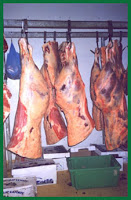 If you have followed this blog for a while you probably know that I am especially interested in Dexters for their good foraging abilities in order to raise grass-fed beef. I came across the “Dexter Cattle Australia” website that has some interesting information on the quality of the beef. Here is a quote that really backs up some of the reasons that I selected the Dexter,
“Dexter beef is second to none. Individual cuts of meat are about two thirds the size of other breeds which is perceived as a more acceptable option in a health conscious society. Whole sides of beef are just the right size for the home freezer…”
You can check out the entire article here. Just click on the “News/Media link for the information
{ }
by Ethan
on September 6, 2007
 Nope, not me! I can’t hit the end yet because I haven’t even started yet, but I didn’t come across an intersting article over at the New Farm website. New Farm is a farmer-to-farmer website from the Rodale Institute and features some interesting articles and a sparsely used forum. I check it every once-in-a-while just to see if they have any new articles on the front page.
A few weeks I came across an article entitled: “The end of farming for me, for now”. (Click on the article title to read the entire thing) Basicall this guy started out with goal and a vision to farm full-time and he headed out to do it. In the article he lists four major problems he had and does a little explaining of his downfall. It really is a great read and has given me a wonderful perspective of the things I could be facing if I reach for this vision. So, just check out the article and leave any thoughts if you have any.
{ }
by Ethan
on September 6, 2007
…I have been wanting to add a picture to the header on my blog for a little while now, and I finally figured out how to do it! It’s not like everyone else didn’t know how to do it, but I’m still pleased with it. I need to do a bit of tweaking still so everything is readable and sized correctly, but it will work for now.
Every time I have gone down to my dad’s place, I have tried to take pictures of the cattle so I can feel a bit like I’m down there when I’m working on my comptuer (they are my background image). Here is the picture that I made the header from. If you scroll down more you will find some more pictures of our bred Dexter heifer and our Dexter steer.
{ }
by Ethan
on September 6, 2007
 This continues to be an interesting read, and as I read more and more I continue to believe that I know less and less! I have noticed Mr. Nation bringing up dairy cattle a lot in his analogies and stories, but this was to be expected because I read that on a few reviews. Dairy cows require a higher level of forage to continue to produce high levels of milk so this information is important to dairy grass farmers, but the higher quailty forage surely doesn’t hurt the beef producers.
This chapter is specifically about year-round grazing in temperate climates, and he discusses different plans and grasses/legumes that would be practical to use in this climate for year-round grazing. Grazing your animals through the entire year is an interesting concept and is one that I am somewhat familar with through “All Flesh is Grass” by Gene Logsdon. To me it seems like it would take a lot of inputs (seed and soil amendments). I don’t know how the numbers would work out, but I question if it is just as economical, or more economical, to make hay during the spring/early summer flush when your grazing can’t keep up with the pasture growth and feed that hay durining the winter months. Also, by using a hay shed type of feeding system like Joel Salatin does I think you may also be able to save more nutrients rather than them hitting a potentially frozen pasture.
There was some interesting information about promoting clover growth among your pasture grasses. The grass can easily outgrow the clover so it is important to keep the grass clipped so the clover can thrive. Another thing that has come up in this book, and in “All Flesh is Grass”, is the idea of feeding standing corn (green … and by the way corn is a grass) along with brassicas (rape, kale, turnips, swedes, and cabbages). These are all interesting ideas, but I don’t know if I am ready to tackle any of them just yet. I think they would be great if I wanted to stock the pastures at a higher level than would be expected even with excellent pastures, but really there is no reason to go to all the work if I don’t have the animals to harvest all of this exceptional food (Mr. Salatin says that a lot).
The great thing about reading a book like this is that it gives me a glimpse into all the possibilities and gives me hope for the small farmer … even in Iowa … the king of corn, soybeans, and really BIG green and red tractors!
{ }
by Ethan
on August 30, 2007
 I received my copy of Quality Pasture by Allan Nation (editor of The Stockman Grass Farmer) last week and have finally had a chance to read the first two chapters. It has been a pretty interesting read, but I have really come away with two points.
Point #1: Recently I have read a few books by Joel Salatin, Carol Ekarius, and Gene Logsdon all relating to pasture raising beef and other livestock. It seems that they all quote each other and other important figures in grass farming like Andre Voisin, but they all have different approaches to obtaining high forage pastures. I would say that Mr. Salatin probably believes less in inputs and more in letting the animals along with the natural work of nature do a lot of the work in creating quality pasture. Next, I think Mrs. Ekarius kind of tries to hit the balance there between the “natural” work and human manipulation through adding things to the pasture (fertilizers, etc.). Possibly I would put Mr. Logsdon third as he seems to be very interested in trying different foraging types on different paddocks in order to obtain the longest pasture season and a high quality. And, finally I would say (according to the first two chapters) that Mr. Nation has a high regard for adding things to the soil and the pasture to make them the most productive. It is interesting to read such a wide range of thoughts, but realize that they are all preaching the same sort of thing … ruminents can be raised solely on pasture and at a lower cost of money.
Point #2: After reading the first two chapters I realized that I’m not very smart! I don’t know very much about microbes, nitrogen, potassium, blah, blah, blah…! It seems like I will have to read this book a few times and then do some outside research to really understand it, but that also seems like a good thing. Like so many things in farming (putting up hay, plowing a straight line, etc.) creating a quality pasture is an art. And, since it is an art it is going to take knowledge, thinking, and creativity. These first two chapters have really piqued my interest and also made me think more about taking some Agriculture classes from ISU if I continue my Bachelor of Liberal Studies program.
All-in-all I’m glad that I picked up this book and I look forward to reading more. It has really given me a glimpse into the depth of creating pasture. Also, even in these first two chapters I am thinking about things we can do on my dad’s farm to increase the quality and productivity (I’m going to be looking into winter rye…).
I’ll try and post an update to my reading every chapter or two, so check back if you are interested.
{ }
by Ethan
on August 28, 2007
Right now my dad’s 160 acre farm is the home to a Minneapolis Moline M5 (53 HP), a 3 bottom JD plow, a disc, a harrow, a rake, and a pull behind sickle mower. We also use from time-to-time a New Holland baler, a JD drill, and a few other implements. The M5 is a nice tractor and can handle all those implements with no problem … except it has no three point hitch and no loader.
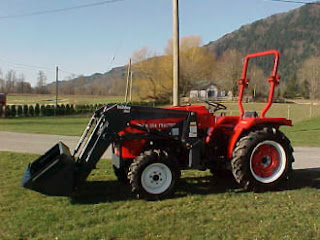 So, when we were done at the auction and working on the fence we stopped to see a neighbor who will be selling Jinma Tractors soon. Jinma’s are Chinese (yuk) 4-wheel drive tractors that are priced much less than the name brand counterparts. You can get a 35 horse tractor brand new for around $10,000 to $12,000. The other nice thing about these compact tractors is that you can get all sorts of implements for them. Some that would be nice to have around the farm would be the box blade, brush cutter, chipper/shredder, log splitter … and above all … the LOADER! I don’t know how many times we could have used the loader around the farm and as we make a transition to making the farm into a working farm it will become that much more important.
Right now I’m doing as much research as I can and basically checking out the options. Once the neighbor has his up and running (the come in crates and take a little assembly) we are going to do some test drives also. For right now you may find this link about Chinese Compact Tractors interesting. Just click HERE.
{ }
by Ethan
on August 26, 2007
 For the past few weeks I have been receiving phone calls from my dad every day or two telling me about my cow that was out! It seems that the old (really old!) woven wire fence on the North side of the pasture wasn’t going to cut it anymore because even our little cow could JUMP over the fence and get out. Yesterday we went down to the farm to put up our electric fence in hopes of curtailing “Cowdini” and to open up some more pasture for them. Along with the electric fence (we used the new solar fencer you can read about below), I also added a few more cattle panels around a couple trees in the old fence line to give some more shade for the cattle (when I say cattle I really me the heifer and the bull calf). It was almost a perfect day to be out and working … well perfect for August in Iowa I guess!
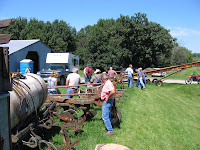 Earlier in the day we attended a local estate auction. They had a little over two hay racks of house hold junk … errr … treasures and then some old equipment. Since it was such a nice day we didn’t mind standing around and watching everyone bid on the junk … err … treasures while we were waiting for the equipment to sell. There wasn’t much for equipment, but a couple of things caught our eye. We ended up getting a like new 100 gallon water tank, a five bottom MM plow (really that’s for the uncle), a flare box wagon (will be good for going to get carbon material), a head gate, and a homemade wagon gear with a pile of junk and tin on top. Everything was going pretty well until they got to the tin. I was interested in the tin for building more chicken pens and for building a moveable shade pen. They started the bidding on the tin and didn’t get a bidder (we wait until it hits 50¢ before bidding), when all of the sudden they decided to throw the wagon gear in also. Well, it wasn’t all bad, because we got the whole shootin’ match for $8.00. Now, I can mess around with that wagon gear and see if I can make a water cart, feed cart, or maybe just a utility wagon for hauling things around the farm.
It was a great day to be out at the farm and it was nice to get a few things done. I’ll be posting pictures in the next few days of how the cattle are coming along. I think they are starting to look better.
{ }
by Ethan
on August 21, 2007
So, awhile ago I discussed the possibility of getting a solar fencer for our rotational grazing system. My dad suggested those because some of the pastures we may start out on are quite a ways from electricity, and also because they possibly would work better for us than a battery system (especially when he is gone and the Amish are doing chores for us). I did some research and found quite a few people that couldn’t stand them and just as many that absolutely loved them. I decided to give them a try. I ended up going with the Parmak “Deluxe Field Solar Pak”. It is supposed to have a 25 mile range and is rated at 1.5 joules. You can read about it here.
 I found the fencer for a decent price on-line at Jeffers Livestock. Since I was already ordering from them and they had free shipping, I went ahead and ordered another book, Quality Pasture by Allan Nation. Mr. Nation is the editor for the Stockman Grassfarmer magazine. It looks like a good book and also reminded me that I need to begin my subscription to the magazine. Maybe I can hold off until Christmas and ask for it as a gift.
{ }
by Ethan
on August 19, 2007
…At least that is what the song tells me! Today our family had a chance to take in the great Iowa State Fair. It has been a couple years since we have been able to go so it was very nice to get back out there and see all the displays and the animals. One of the newer activities they have at the fair is a children’s farm experience. The children get to go through the sequence of farming and learn along the way. They start out by picking up a seed corn hat (required apparel by Iowa farmers), a basket, and an apron (I guess that is to keep them from getting dirty). Next they go pick up a “seed” with the picture of the plant that it is for on it and a shovel so they can go plant their crop. After that, they go “harvest” a plastic toy of the crop they planted and place it in their basket. As they walk along the path, they come upon some “apple trees” where they can “pick” an apple and put it in their basket. Next they walk through a little grain bin to pick up a baggie of soy beans and corn and then continue on to the chicken coop where they gather an egg. After that, we walked over to the tractor shed where you turn in your soybeans in order to make Soy Biodiesel. Then you pick up a little gas can to fill up your pedal tractor and make a lap around the “field”. After the tractor ride, you get off and walk through the sheep barn where you can pet a fake sheep and pick up your baggie of wool. Then you walk straight to the milk barn where you give your corn to the cow for feed and make your way to the milking parlor where you milk the cow! You pick up a milk carton there and place it in your basket. Finally, you are off to the market where you turn in the things you have harvested and produced on your farming trip. After “selling” your things at the market you get a dollar that you can go spend in the general store stocked with all sorts of treats!
Our kids had a blast doing it, and it was a good educational opportunity. In other news, Caleb (three years old) and I had a long talk about “his” farm last night. It seems he will have a blue house, red barn, Minneapolis Moline and John Deere tractors (gotta keep both sides of the family happy), some cows (Dexters), chickens, pigs, and more! I think he is ready to farm … maybe now he can help me get a start.

{ }
 The title of this chapter is, “Quality Pasture For Warm-Temperate And Subtropical Climates”. The title kind of sums up the lack of real practical application information I found in this chapter. I don’ think you could call Southern Iowa “Warm-Temperate” or “Subtropical” unless you were comparing it to Northern Iowa!


Join the Community