by Ethan
on September 20, 2007
Here is an interesting video featuring Joel Salatin of “Pastured Poultry Profits” and “Salad Bar Beef” fame. There is some pretty good stuff in this little clip (8:28 long) about building forgiveness into your farming system (or flex). I hope you enjoy it and can grab some kernels of interesting information from it!
{ }
by Ethan
on September 18, 2007
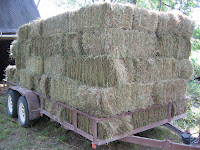 Do you know how to paint a beautiful picture? Can you mold a lump of clay into a wonderful sculpture? Are you able to take an amazing landscape portrait? Do you make art with your music and your voice? Well, I don’t really know much about any of those, but I do know one thing…
Baling Hay Is An Art!!
Now, before you think I am absolutely crazy let me explain… First of all you need to know when is the perfect time to cut the hay. This isn’t something that goes by calendar or clockwork, it is an art to know the perfect moment to cut to get the perfect hay. Secondly, you need to know when to rake and how to rake your hay. This isn’t something that you do a certain number of hours after the cutting … it is an art … it is a feeling. Next you need to bale your hay, which means you have to set the tension just right, make the bales just the right size, and make sure you get all the hay into the baler. Finally, comes the most artful part of the art of haymaking. You need to stack the bales onto your hayrack and then into the barn. Getting them in an orderly manner is no pell-mell operation. You must know just where to place each bale so all your corners are tied in and the rack is ready to go down the road … oh, and it helps if you can go six or seven levels up! Then into the barn it goes.
We stack our bales on the sides so all of the stems are sticking up and down instead of stacking them in the normal way. We do this because that is the way grandpa did it … no, really that is the way grandpa did it, but it also helps the moisture wick out.
Yesterday we baled around 600 fifty pound small square bales of grass hay down at the farm. It was a warm day and lots of hard work. Even though I’m sore now I enjoyed it very much. I enjoyed the warm breeze … I enjoyed working as a family … I enjoyed the sound and feel of the tractor and baler … I enjoyed the scratchy hay … I enjoyed the art (I guess I should say I enjoyed learning the art)
{ }
by Ethan
on September 17, 2007
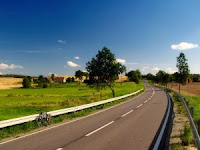 Today I’m not talking about the long road to becoming a farmer (although it seems endless), rather I’m talking about the long road to the farm! As I mentioned before, our cows are located over an hour away at my dad’s farm in Southern Iowa. It is a great place for them to be because there is plenty of pasture, and he needs something to eat down his grass in places. But it sure is a long ways away when we have to go down and do something (put up fence, build shelters, take down wormer or minerals, and to bale hay). Having a full-time job that already takes a lot of time away from the family and then adding in work days down on the farm on the few days off that I take makes it pretty tough.
I have joked quite a few times about wanting to put our cows in the backyard (we have a big yard), but everyone reminds me that it is against the law. I wasn’t ever serious, but I think people wonder if I really am since we already have the chickens in town! Ideally I would love to find a place where we could do more farming near where we work and live now, but that just isn’t happening yet so we have to make do with the opportunities that we have.
You will always have time for whatever you want to have time for, and right now we want to make small amounts of time for working on the farm away from home … I just hope it doesn’t last forever!
{ }
by Ethan
on September 15, 2007
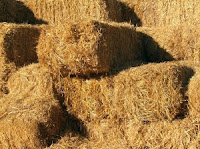 Well, one of the bummers of not living on the farm (or near the farm for that matter) is that you don’t get in on all of the fun. In this case I missed the cutting of the hay. We have not made any hay yet this year because we haven’t been able to get schedules and equipment to meet up at the same time, but now we are ready to go. This past Thursday and Friday my dad got all of the hay cut (well, all that we will need) and this coming Monday we will rake and bale it. We only have two Dexters right now, but we may end up with as many as 800 or 900 small square bales. I think that should be enough! In fact we probably will be able to get a cutting of alfalfa this year yet because of the warm fall they are predicting and another cutting of grass hay that has recently come out of CRP. We will practically be living in hay!
With the the over-abundance of hay, it is making me wish that we had some more cattle to feed. If only I could find somebody wanting to unload their Dexters. But, we are probably better off with just our two considering we don’t live near them.
I do wish that I was able to be more involved in the day-to-day operations, but I guess all things will come in time. At least I pray that is true. Look for a report Monday night or Tuesday from the baling.
Edit :: Well, there is one sure fire way to predict rain it seems. Cut your hay! There was no rain in the forecast this weekend, but there was some next week so I urged my dad to get the hay cut before the rain … today rain … out of no where … well at least to the weather man it was out of no where! My dad’s Amish neighbor told my dad that it would rain today and of course he didn’t look at a forecast. He just knew it would rain because we had a frost last night. I guess you learn something new all the time. Oh well, we still have some stuff still standing.
{ }
by Ethan
on September 14, 2007
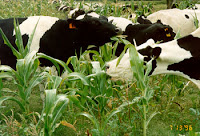 I’m going to be signing up for a subscription to The Stockman Grass Farmer magazine soon, so I was searching some the articles featured on their website and I came across this article titled, “Iowa farm family converting from crops to pasture based enterprises” by editor Allan Nation. It is a pretty good read about a family farm that converted from conventional Iowa farming to pastured sows, grass finished beef, and lambs.
The interesting thing is that it was a plan of conversion that they were slowly working on until their area suffered from a drought and another grass finisher was looking to unload some steers because of his suffering pastures. It didn’t take them long to realize they could put those steers out on the green corn that the family had (which was certified organic). Long story short … they are now doing something different than their neighbors and they are succeeding!
Click on the link above to read this great article and leave a comment if you would like.
{ }
by Ethan
on September 13, 2007
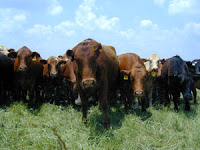 Yesterday I finished chapter seven, ‘The Competitive Edge — MIG’, in Allan Nation’s book “Quality Pasture”. I found this chapter very interesting and informative and will probably have to reread it multiple times so I can digest all the great stuff! I’ll just run down some of the highlights of this chapter.
Mr. Nation begins the chapter talking about some of the benefits of Management Intensive Grazing. Of course one of the biggest benefits is the higher stocking rate and pasture gain that you can get from having a MIG system in place. But, he also quoted Keith Milligan, of New Zealand, on his list of benefits. Mr. Milligan adds that MIG produces, “a better return on total investment, a lower labor input, a general conservation of the environment, and a much increased sense of peace of mind for the grazier.” I think everyone will find these benefits appealing! Just so you know the experts believe MIG could raise your per acre production by 20% to 40% or higher if you can be flexible with your stocking rates according to the season.
He mentions some of the critical things for MIG: subdividing you pastures by geography, having access to clean water, using portable electric fencing, stockpiling forages for late fall/winter/early spring grazing, and spring pasture management to reduce damage to the pastures. He admits that this is a very rough and quick overview of MIG, but it is a great starting point to some of the more technical aspects. I think one of the things I learned in this chapter is that MIG is more than just moving your cows from chunk of grass to chunk of grass.
I’ll leave you with this little chart from page 128 of Mr. Nation’s book Quality Pasture. This list gives some different enterprises and average returns per acre. Very interesting stuff and made me think about my possible center piece operation.
Goats :: $50-200
Beef cow/calf :: $50-200
Pigs :: $150
Beef stocker :: $150+
Beef finishing :: $200+
Ewe lamb :: $400+
Dairy sheep :: $500+
Lamb finishing :: $1000+
Dairy beef :: $1000+
Pastured poultry–
eggs :: $30-50
meat :: $1000+
Seasonal grass dairy :: $900-2000
So, there is some food for thought! I do like the last three sentences of the chapter, “As Burt Smith said, ‘The best way to learn to swim is to get in the water and start splashing around. Nobody ever learned to swim by just reading a book about it.’ Are you reading to make some waves?”
Hmm… am I ready to make some waves? I think I am, but what will my next step be?
{ }
by Ethan
on September 12, 2007
 Those were the words I heard from someone the other day. As far as I know this person has never farmed a day in his life and his family really hasn’t been in farming either, other than living in agricultural areas. The interesting this is that they went on to say, “unless you have a lot of land and money to begin with.” If someone said this to me about other areas of work I would probably believe them and just move on. But, I think there is money in farming. Not from a get rich standpoint, but from an enough to be comfortable with standpoint, and I think there is enough enjoyment for a person with my personality to make farming worthwhile.
So, is it true that, “there is no money in farming?” Well, yes and no. There may be no money in conventional Iowa farming, but what if you are unconventional … what if you think differently … what if …
Edit: Bill reminded me, in the comments, of THIS POST from Homesteading Today about different money making opportunities on the farm. It is a great post full of ideas, facts/figures, and so much more. If this topic interests you then you need to read the posts. Thanks Bill!
{ }
by Ethan
on September 11, 2007
 I’ve had a link to the Practical Farmers of Iowa website over on the links menu on the right for a while now, but I just wanted to point out this great organization. sydney sweeney commercial The tag line for their vision statement say, “Healthy Food, Diverse Farms, Vibrant Communities.” (check out their entire vision statement by clicking on the quote) The ‘Wild Country Ranching’ field day I attended earlier this year was supported by the PFI as well as the Farm Crawl that I will be attending on October, 7th. They host field days with a wide range of topics all over the state of Iowa and are a source of so much good on-farm research and information.
The Practical Farmers of Iowa was birthed from the farm crisis that crippled the Midwest in the 1980’s. According to their website in the eighties, “Evidence of the negative ecological consequences of current farming practices was mounting; the collapse of commodity prices called into question the economic sustainability of agriculture; and the demise of thousands of farms was draining the vitality of rural communities.” The PFI is helping farmers in Iowa connect with each other to share ideas, success, and marketing ideas. I encourage everyone to check them out.
Practical Farmers of Iowa Website
{ }
by Ethan
on September 10, 2007
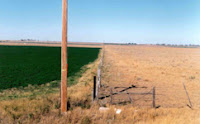 Just a quick little report on the last chapter of “Quality Pasture” that I read. This chapter was entitled Pasture Irrigation. While I do not doubt the effectiveness of irrigating your pastures … I do not believe it will ever be a thing that I do. Of course it is needed much more in dry locations, but it is also probably more effective for grass based dairies. The chapter also contained a short section on managing ryegrass which was interesting. Ryegrass is something that I would like to research a little more in the future if I ever think about seeding or over-seeding some pastures.
All in all, I think this chapter gives a much more input intensive approach to grazing. I would like to keep my inputs low (much like Joel Salatin discusses) so that my profits will stay higher than conventionally raised beef.
Next up: Management Intensive Grazing
{ }
by Ethan
on September 10, 2007
 I don’t remember when I came across THIS or how I found out about it, but it is pretty funny. It is a spoof of “The Matrix” dealing with confinement dairy, beef, and poultry. I don’t know where I stand on all of the content. While I strongly disagree with the confinement production model from a health and financial stand-point I’m not openly opposed to it. That is probably just because I’m an Iowan and I’m indoctrinated into the confinement system. I do believe that there are people doing limited confinement operations and doing them well, you just don’t find very many.
So, check out The Meatrix and tell me what you think!

{ }


Join the Community