by Ethan
on August 18, 2007
 I’ve been re-reading some of the farming/grass farming books that I have lately. I’m trying to put together some plans and goals for our farm. hot adthomasx Yesterday I landed on the chapter entitled, “The Ten Worst Agricultural ‘Opportunities'”, in the book You Can Farm: The Entrepreneur’s Guide to Start & Succeed in a Farming Enterprise
 by Joel Salatin. According to him, the number one “worst agricultural opportunity” is “Seedstock Anything”. He goes on to say, “Leave the purebred business to the independently wealthy folks with deep pockets.”
That quote kind of hit me like a ton of bricks. I remember reading it, but I also became pretty set on Dexters early on in my research because the foraging ability, size, and a few other things. Another quote from that section of the chapter states, “Unless a seedstock operation can be profitable on commercial prices, it is not really viable.” I am not completely sure where Dexters land as far as commercial prices go, but I know that I chose the Dexter breed not because of seedstock opportunities. I chose them because I thought they could help me fill the freezer beef niche by offering high quality grass-fed beef that is healthy and will fit in your basement freezer. I did not, and do not intend to base my business only on seedstock, but I will admit that I saw that as a possibility because Dexters have a lot of appealing attributes for the “homesteading” type of families.
I am going to spend some time researching a business plan for my Dexters that can take advantage of all of their marketable traits … whether it be beef, milking, oxen, or even pets. But, I do agree that only being in the seedstock business is something that will take a bit of money and time to build up the reputation of a high quality breeder.
{ }
by Ethan
on August 11, 2007
I just stumbled across this blog link for Clodhopper Farm
Clodhoper Farm. I don’t know who these folks are, but it seems like they have a nice farm thing going on. I’m going to put this over in my links section so people can check it from time to time if they would like. It seems like they are doing some of the things that I would like to be doing. I guess you could say they are a few steps ahead of me!
{ }
by Ethan
on August 11, 2007
 Well, not exactly totally done … but we did finish the basic fencing for the pasture. Our 1 to 2 acre pasture now is totally fenced in with cattle panels (because they were free). Even though I haven’t decided what to do as far as a solar fencer, I decided to let them out on pasture so they could get to some fresh grass and ditch the hay belly. They loved the opportunity to roam, and I must admit that they look a little bit nicer when they have a nice green pasture as background. I meant to bring the camera for when I finished up my work, but I’ll have to take some pictures next time because I walked out the door without it. Hopefully, our steer will start to bulk up a bit and get rid of his bloated hay belly now that he has some access to good grass.
{ }
by Ethan
on August 9, 2007
 One of the key componants of managed intensive grazing is the electric fence used to seperate the temporary paddocks. A single strand of wire with easy step in posts will do the trick, but you need to have power in order to have a “hot” wire. My dad’s farm (where our Dexters live) is not set up much for running electric fence. Right now the horses are out on pasture inside of an electric fence energized by a battery powered fencer. I had planned on going that route, but now I am looking into the possibilty of a solar powered fencer.
I’ve read good and bad about solar fencers. In fact you can read a little bit from my post on Homesteading Today by clicking here. A couple of the limiting factors to me are the initial cost and the reliability. A solar charger is going to cost anywhere between $130 and $500 (for the big boys). I don’t know if I am in a place to lay out that kind of money right now, especially if realiabilty is going to be an issue. I have read of some people that swear by them and say they are just as reliable as any other battery operated fencer, and I have read that they are nothing but trouble.
I am going to continue my research, but I need to come up with something pretty soon so we can get these cattle moving around their pasture. I expect the grass will really take off with the 3+ inches of rain they received down there and the coming heatwave!
{ }
by Ethan
on August 5, 2007
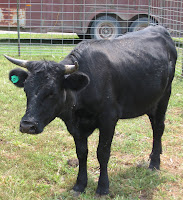 Who knows how long it has been since cattle have clipped the grass of the pastures at my dad’s farm (probably over 20 years ago), but they are there now! Yesterday my dad and I went up to Grandma’s Dexter Farm to pick up our cow and a bull calf (soon to be steer). We went with the idea of picking up Karen (pictured in posts below), but when we arrived he had a few younger and better looking choices for us. We ended up bringing home a 2-year-old heifer who is bred to calve in the spring. She is quite a bit younger than the other option, but she will also be a first timer this spring so that factored into the choice I had to make. After talking with my dad and deciding that we could make it work, we ended up bringing home RAD’s Victoria (don’t you just love registry names!). Oh, and a bull calf … soon to be a steer … and later to be supper.
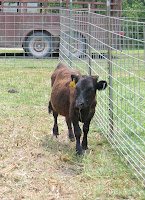 These two have mostly been fed hay their entire lives (the bull calf probably his whole life) so I think they will start to fill out a little more and get a little shine back to their coat once they get on some good pasture. We are going to ease them onto the pasture so they don’t gorge themselves on the fresh grass and become bloated. Right now they are in a rather small paddock, but it won’t take much to get them out onto one of the pasture paddocks that will be divided by electric fence. I’m excited to have this little start going and to learn about grass-finishing beef and rotational grazing (I don’t think we will be able to call it “managed intensive grazing” until I make it down on the farm).
Be sure to stop by next fall for some great grass-fed (or salad bar if you’re Joel Salatin) beef!
{ }
by Ethan
on August 1, 2007
 I must admit that out backyard chickens and impending (still!) dexters has kind of side tracked me from some of my initial farming thoughts and ideas. A couple of the first farming “ventures” that I began researching were pasture raised pigs and raspberries. Yesterday I found myself reading a post over on www.homesteadingtoday.com (check out the link on the left) about profitable farming ventures that some people are pursuing. As I read along, I was interested to see that there were people raising pastured pork and profiting from it. My initial thoughts on the pigs was that here is something that can reproduce up to a couple of times a year and grows out to finish weight rather quickly (especially compared to cattle). Well, that post brought me back to my original ideas … pigs and berries.
During some of my work breaks yesterday and today I have been trying to find some articles and information regarding pasture raising pigs. Things like breeds, forages, shelter, farrowing, etc. It has been pretty interesting, and I have found some things to check out. One thing that I am really interested in is finding the right breed or cross for this type of system. Most of the time the “heritage breeds” come up when people talk about pastured pigs, so I am specifically looking for information and Iowa breeders of the tamworth, the large black, glouchester spot, berkshire, and maybe some more.
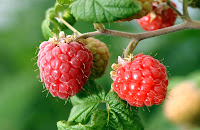 But, pigs weren’t the only thing on my mind. The pigs brought the raspberries back to the front of my mind (Nice combo, huh? Stinky pigs and juicey berries). I remember reading that it takes about three seasons for newly planted raspberries to begin producing. I think I would like to plant some this fall if possible in hopes of getting a jump on that possible farming venture. We can start out small and then expand. I know one thing for sure … if we plant berries and end up doing nothing profitable with them, I can count on my family to eat ALL OF THEM!
Any thoughts, ideas, info?
{ }
by Ethan
on July 30, 2007
 I am currently reading “Salad Bar Beef” by Joel Salatin for the second time. I don’t really want to become a person who worships Joel Salatin, but I wanted to get a second look at his ideas on grass-fisished beef. This time, as I read, I highlighting some of the more interesting or important things … partially for my own use and partially for my dad. I’m hoping that he will read it as we are going to be entering some some this farming thing together.
One thing that I have really noticed as I reread “Salad Bar Beef” is that there are lots of different take on this whole “grass-finished beef” idea. Gene Logsdon’s book, “All Flesh is Grass”, takes a pretty experiemental approach to finishing beef. He writes about experimenting with different grasses, legumes, and other ideas. The thing about Mr. Logsdon is that he is not really a “full-time” farmer (meaning he does not get all of his income from the farm) and that he likes to try different things. His book was very informational for thinking outside of the conventional farming “box”, but also seemed like a bit more involved approach.
Mr. Salatin is very much straight forward in his approach. He tells people to get animals before reseeding pastures, adding lime, or anything like that. Also, he preaches the idea of growing in your fields what grows in your ditches and leading the animals and the natural progression rehabilitate your pastures. I think maybe Mr. Salatin would agree with my uncle’s quote, “reading is good, doing is better”. He wants people to start doing and then see what needs to be done in order to increase the lands cattle carrying capacity.
Finally, as I reflect on the field day that I attended last week I am really seeing the many different approaches to making a living raising cattle through value added or sustainable practices. The DeCook’s ranch that I visited last week was around 800 acres and they were raising 500 head at a time on their ranch (cows, calves, yearlings). I would say that they were practices a sort of rotational grazing but not really a managed intensive grazing approach. For example, when we visited they had 200 dry cows on about 40 acres. He was planning on leaving them there for four or five days. In talking with him it seemed that his greatest limiting factor was water.
Which brings me to a few things that are really on my mind right now. First of all, I’m very interested in learning more about and putting into practice some electric fencing ideas. I liked what I saw at the DeCook ranch and I’m interested in the things I read in Mr. Salatin’s book, but I would like to see things in practice. Secondly, I would really like to learn more about watering systems so that I don’t have that limitation on my setup (if I ever have a setup!). And finally, I would like to read some more books to continue to get a different prespective (or talk with other people). I am thinking about checking out some of Allan Nation’s books, of the “Stockman Grass Farmer”, but I’m having a difficult time choosing. If anyone does actually read this blog let me know if you have any ideas.
{ }
by Ethan
on July 28, 2007
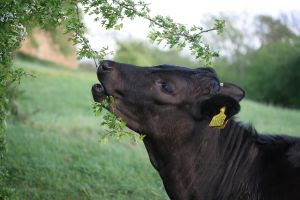 It has been a long time since I last posted a blog. I haven’t forgotten about this … my life has just taken on a extra bit of busyiness. Just because I have been busy doesn’t mean that I have stopped thinking, reading, and doing farming. Since my last post I have finished a couple of books (Salad Bar Beef – Joel Salatin and All Flesh is Grass – Gene Logsdon), sent final payment for our cattle (but not picked up yet because of a important family issue), built fence for the cattle, and done a lot of talking with farmers and family.
But, today I had a chance to go to my first PFI (Practical Farmers of Iowa) Field Day. The day was hosted my the DeCook family which farms about 20 miles south of where I live. They raise grass-fed beef on about 800 acres (around 500 head of cow/calves). It was a great tour of their farm that included five stops for some great explanation and question/answer time. I learned a lot about pastures (seeding, management, forage types, and more), fencing, water, and just some good conservation practices. The DeCooks do not run their farm exactly as I have envisioned mine because they do not finish their cattle, but they do send them off to others to be finished on grass so they select for good foraging genetics. It was a very enjoyable morning full of information. I also heard about a couple other field days coming up that I would like to attend. One is next week and focuses on portable fencing and solar water pumping (something I think could be very helpful on my dad’s farm).
Hopefully we will have a chance to post some pictures of our cattle at home on the farm soon. Remember, reading is good … doing is better!
{ }
by Ethan
on June 20, 2007
Okay, we have placed a hold on the dexter cow Peaceful Place Karen (who is bred back) and a steer named Rocky Road. Hopefully Karen will become the start of our herd and Rocky Road will become our first grass-finished freezer animal. So, in about a year from now you might want to hit us up for some good eatin’!!
We aren’t going to be picking her up until the middle of July after we get back from the Mission Trip and Camp … also, it gives us some time to get the fencing finished up at my dad’s.
Here is another picture of Karen…

{ }
by Ethan
on June 18, 2007
It has been a little quiet lately on the “Beginning Farmer Blog”, but that doesn’t mean that farming thoughts and discussions haven’t been occuring. Lately I have really been researching grass-finished cattle and looking at the Dexter breed specifically (as I mentioned earlier).
Well, this past weekend we had a chance to go and check out one of the larger Dexter herds in the area. We went and saw the herd at Grandma’s Dexter Farm which is located north of Cedar Rapids. It was nice to get out and see some of these cattle in the flesh and talk with someone that has been around them. The owner of the farm was Dan Butterfield and had a lot of answers to some of the questions that had been bouncing in my head. One of the great things was to see a large number of Dexters … Dan has around 40 now, but has had over 60! I spent about 20 minutes in the cattle lot with him among the cows and the bull and I can easily attest to the fact that they are very calm. While we were in there he pet his bull as the bull sniffed my shoes and had a few different cows come up to say hi.
Besides just checking out the breed in general we also went with the purpose to check out some cows that he had for sale. One in particular is Peaceful Place Karen … who is pictured below.
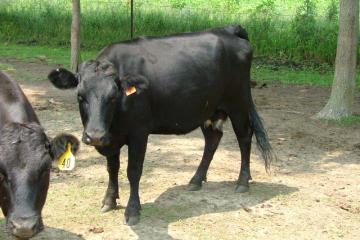
That isn’t the greatest picture of her, but she is a good looking dehorned cow. If we got her we would also be picking up a steer to finish out for our freezer and she is bred back to calve next year. I’m pretty excited about the possibilities, but I’m trying to do a little more research first. I think I’ve talked to four different herd owners in Iowa, and I’m trying to set up an appointment to check out another herd in person.
Along the grass-finished lines I have also recently ordered Joel Salatin’s book “Salad Bar Beef” in hopes of learning some finishing tips and pasture ideas.

{ }
 I’ve been re-reading some of the farming/grass farming books that I have lately. I’m trying to put together some plans and goals for our farm. hot adthomasx Yesterday I landed on the chapter entitled, “The Ten Worst Agricultural ‘Opportunities'”, in the book You Can Farm: The Entrepreneur’s Guide to Start & Succeed in a Farming Enterprise


Join the Community