by Ethan
on October 1, 2007
 I just finished up reading chapter 10 of “Quality Pasture” by Allan Nation. This chapter was titled, “Seasonal Grass Dairying”. I knew from the title that there wasn’t going to be a lot of specific information in this chapter that would be useful for any operation that I was thinking about at the time, but it was still a good read. Dairying seems to a be an art, kind of like baling or just about all farming, that takes a good amount of knowledge about animals, health, forages, and more. I’m not about ready to tackle that right off (did you read my post about the farmer who hit the end), but I did find a lot of interesting nuggets in this chapter.
The most encouraging thing I read was the examples from real life farmers who are making grass based seasonal dairies work. So often when you mention some ideas you find from sources such as Joel Salatin, Allan Nation, the Stockman Grass Farmer, and other books/periodicals you get the standard Iowa farming tradition answer, “well, that won’t work for you or here”. But, this chapter proved that there are plenty of guys out there that are feeding forages for their main feed and running a seasonal dairy for a decent profit. Plus, the get the benefit of a few months off!
Another interesting thing is how America seems to be lagging behind in terms of thinking outside of the grain box (or should I say bushel basket). One interesting piece of information comes from Carl Pulvermacher a Holstein grazier from Wisconsin.
“He said his 68 acres of pasture land currently grosses #1430.70 per acre ($1305.20 from milk and $125.50 from meat) compared to only $402 from his corn ground (162 bushels at $2.50 – grain is higher now – per bushel).” –Quality Pasture by Allan Nation (pg. 186)
It seems like sometime our farmers would catch on to things like that … but, maybe I’m just missing something? Please let me know if I am!
The last thing that I found really interesting in this chapter was a list of cost cutters for most dairy producers. While it is geared for the dairymen I thought it would be just as important for a beef cattle producer:
- Get Your Breeding Season In Sync With the Pasture
- Stop Grain Farming
- Concentrate On Cutting Feed Costs
- Minimize Machinery Costs
- Increase Stocking Rate
- Be Realistic About Animal Genetics
- Don’t Blame The Animals For Lack Of Profits
- Change As Fast As Possible
If you have any thoughts on these things I would love to hear them!
{ }
by Ethan
on September 30, 2007
 Yesterday was the day that we headed to Missouri to pick up our two new cows, one new heifer, and one new bull calf. We left Knoxville around 8:30 am with our family to pick up the trailer and get on the way. It was going to be a nice drive on a nice day with a stop at a picnic spot for some food and fun and then off to loading up the new additions to our herd. As we were pulling out of the farm, I mentioned to my dad that this was kind of cool, because I was the third generation of Books to use this trailer to pick up livestock. My Grandpa had the trailer made by a technical school in the late 60’s and he, along with my uncles and my dad, had used it ever since. It was great … it was nostalgic … it was BROKEN!!!
When we stopped for lunch I noticed one tire on the left side was a little crooked … not a good thing! Well the short of it is that we threw a bearing on that side, we had massacred the hub, and it was Saturday afternoon in sleepy Bethany, MO. Every shop we stopped at said that we weren’t going to find any help on a Saturday, until I went back to O’Reilys the second time. That time a clerk was up front that new of a trailer dealer about 10 miles away that might be able to help. He had the pieces, my dad have driven over with tools, and at about 5:30 pm we left the side of the road and finally headed down to the Anderson’s Farm to pick up our Dexters. You can see from the picture that it takes a lot of thinking to replace a bearing … especially when you don’t do it very often!
 But, that is enough of that. You can check out my WIFE’S BLOG for more details. I don’t really want to think about it any more!
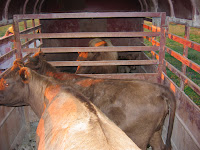
I was really excited to pick up these Dexters because it would grow our herd by four, it would add some color to our herd, and the ten year old is bred to calve this coming year (which means we will have two calves in the new year). Since we didn’t get them to their new home until around 10:30 pm, I wasn’t able to get any pictures of them in the new pasture, but you can check them out in these two pictures that were taken while we stopped to check the hubs (not a perfect fix, but it was a fix).
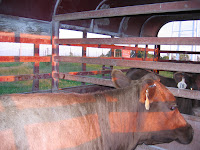 In the first picture you see (going from top to bottom we have Ginger and her calf, then Billie the heifer, and finally Mandy the ten-year-old cow. In the second picture you can get a nice close up of Ginger. She may be a little more short-legged than Mandy or our other two heifers. Some Dexter breeders really like the short ones. I think they all look pretty good right now, and I’m looking forward to seeing them in the daylight on their new pasture! My dad tells me that they blended in with the two that we already had, and they are all hanging out in the pasture together. Hopefully we can drive down this week and check on them. There is always work to be done on the farm so we would have a good reason for going!
{ }
by Ethan
on September 28, 2007
 When I registered in the American Dexter Cattle Association they asked me what my farm name was. Well, I thought to my self … “I don’t have a farm, how can I have a farm name!” So, I told them that I didn’t have one yet, but that I would come up with one soon. In the registered purebred livestock world you must have a farm name to identify animals bred on your farm. For example our heifer’s name is RAD’s Victoria because that is where she was bred and born. There was no hurry for us to come up with a farm name because we won’t have to worry about having our name in front of a registered animals name until spring 2009.
That being said, I wanted to come up with a farm name anyways. I am sort of particular when it comes to things like farm names or names in general. Case in point, it took me over a month to come up with a name for our new puppy so we just had to call her pup for awhile. I wanted a name that had meaning, that didn’t sound weird, and wasn’t really tied to a certain place because we don’t even know where our farm will be located. Also, because I am very passionate about history in general and America’s founding history in particular I wanted it to be a name with historical significance. I thought through quite a few names, but couldn’t settle my mind on anything.
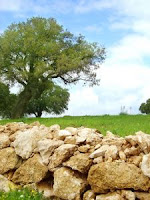
Last night as I was trying to fall asleep I had a thought. Why not name my farm after John Adams’ farm. John Adams was a founding father, he loved farming and agriculture, and he had a small farm that he personally worked on rather than a huge estate with many slaves or lots of workers. I grabbed my John Adams biography by David McCullough and started searching. It seems that President Adams originally named his farm, Peacefield. That seemed like a great name, but I wanted to see how many people were already using it … I guess a lot of people had the same great idea that I had because there are quite a few “Peacefield Farms” out there. But, I remembered reading something about President Adams’ later in life changing what he called his farm in journals and personal letters. It seems that later on, among other names, he began calling his farm, “Stoneyfield”. A quick internet search came up with not much. Just some yogurt company that spells it without the “e”.
So, Stoneyfield it is. I like the sound of the name … it sounds, “old” … it is simple and isn’t tied to a certain farm … and, it has great historical significance. Hopefully we can use this as our farm name now and in the future.
Not much farming or research in this post, but now that we have a name maybe I will think of setting up some sort of advertising or marketing for the calves and such that we will have in the spring. Maybe we could even sell some of our eggs using this farm name?
{ }
by Ethan
on September 27, 2007
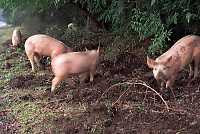 One of the reasons that Dexter cattle were so appealing to us was that they were great foragers and browsers. In fact I think I had my dad sold on the breed when he talked to a breeder in our area of the state that said they will even eat multiflora rose. Well, our farm is over run with multiflora rose so my did really liked that idea. One of the goals of our farm is to reopen many of the places that have been over taken by brush, junk trees, and cedar trees. In one section of the farm we have what we call fingers … these are little grass ridges with very small valleys (20 yards wide maybe) full of brush and trees. When we first moved there these areas weren’t especially overrun, but now they are a tangled mess that you can barely walk through. The thought of clearing them and keeping them clear of the brush and ground cover is very daunting.
But, I have come across a couple of interesting articles that talk about using pigs as clearing instruments. It is not like we can just let the pigs come in and clear it all up, but it seems that if we went in and did some manual clearing, selecting some trees to harvest and some to leave and knocking down some brush, we could then send in the troops … err … pigs to finish up the job and help turn those messes into savannah type ares.
In an article titled, “Virginia grazier Joel Salatin finds pigs can profitably create pasture from cut-over forest lands” from The Stockman Grass Farmer Joel Salatin is doing just this sort of thing to reclaim some areas that he has logged. The article says that Mr. Salatin’s, “oldest pig pastures have volunteered into a mixture of perennial ryegrass and crabgrass. He doesn’t know where the seed came from and said the pig pastures are the only paddocks on his farm with perennial ryegrass.” There is another upside to his pastured pig model … he profits about $3,000 per acre selling this hogs directly to his customers. His pig pastures are about two acres in size and are split up into eight smaller paddocks with around 40 pigs in each pasture. The paddocks are divided by two strands of electric fence powered by solar fencers.
Another article I ran across the other day as I was reading the Homesteading Today Forums was an article by Joel Orcutt titled, “Hog Tractor (How To)”. This is an interesting article that speaks to these “hog dozers” on a smaller level than Mr. Salatin. In this article Mr. Orcutt talks about using movable pens to eradicate weeds or prepare areas for gardens or other types of plantings. Again, the principle is the same … the pigs will root up the area, spread manure, and prepare a seed bed.
This is something I am going to be discussing with my dad. Maybe we can get hogs on the farm a little more quickly with a model like this rather than waiting until I am out in the country. I do like to eat pork you know!
{ }
by Ethan
on September 26, 2007
 I try to spend a little bit of time each day researching farming, reading about farming, practicing farming (doesn’t happen as often as I would like), or planning in my mind and on paper. I that I have come across quite a few neat blogs and websites that are very helpful. One blog that I have been checking out a lot lately is the Sugar Creek Farm Blog. Sugar Creek Farm is located about three hours north of where I live here in Iowa and I have enjoyed reading about their work. They are doing a lot of things that interest me so I have found a lot of good information reading back through their blog. You can check them out by clicking on the link above or by looking at the links section on the right. (The image pictured on the right is their logo)
Another link I have been looking at lately is the Farm Crawl website. The Farm Crawl is an event that I heard about through the PFI. On October, 7th from 11:00 am until 5:00 pm five area farms will be open to the public for tours, questions/answers, and sales. These farms are all within about 15 minutes of our town so I’m looking forward to checking out something very local. You can click on the link above or on the right to get all the details, but I’m really interested in checking out the goat dairy, and the 110 acre farm that is being rebuilt to profitability through great farming practices!
Another blog I check out often is, Northern Farmer. They are located in Minnesota and have a love for farming, faith, and family. I have enjoyed reading many of their posts and I encourage you to check out the link if you find this blog interesting.
**UPDATES**
Just a couple quick updates. First of all I mentioned a few days ago that we were going to pick up some new Dexters to add to our herd. Some of you may be wondering why I have posted pictures of them at their new farm … well, that is because they haven’t made it yet. In order to move livestock from state to state you are supposed to have a certificate of health for the animals and the vet wasn’t going to be able to check them out until this coming Friday. Because of this we won’t be going down until Saturday, which will be fine because we are going to make it a fun family trip. Look for new pictures of our herd next week. Secondly, I have added a few links and rearranged a bit over on the right side, so check that out.
And, finally … the main reason that I’m running this blog is for my own benefit. I’m a sort of a visual and thinking learner, so it helps me digest information if I can write it down and check back through it from time to time. Since I was going to be writing it down anyways I decided to put it out there for everyone to check out. As you have noticed it is mostly random thoughts and links to other information that I have found useful. If you enjoy reading this blog feel free to pass it on to others who you think would enjoy reading also!
{ }
by Ethan
on September 25, 2007
 This chapter is titled, “Stored Forages”, but it easily could have been called, “A Little Information About Nasty Hay, and an Intense Look at Silage.” But, I guess that title would have been too long! Really, it was an interesting chapter, but I was surprised how quickly Allan Nation, the author, dismissed baled hay. He believes that hay is a good option in more arid climates (West?), while it may be a poor choice in moist or humid climates that receive decent amounts of rain.
I don’t know if it is a little bit of, “conventional Iowa farmer”, in me or what, but I don’t know if I would write off hay so quickly. That being said, I do understand the benefits of silage, and if you are set up for that it can be slightly easier to harvest and store (although I absolutely love making hay, not that that is a good reason to keep doing it). Approximately two pages are dedicated to hay in this chapter, and the rest is dedicated to silage.
The conclusion that kept coming to my mind is that if I was doing a grassfed dairy on any scale or if I was keeping large herds with lots of land and capital, I might investigate silage more. But, in my part of Iowa we can get a decent small square baler, mower, and rack for a reasonable amount of money. Granted you will need a building to store the hay in, but in reality those buildings don’t have to be anything overly special.
One interesting point that he mentions a few times in this chapter is that it would probably be more cost effective to have a contractor do all of your silage making rather than owning your own equipment. This will be an interesting thing to pencil out in the coming months and years, but I do see some benefit for this type of thinking.
So, does anyone have any thoughts or experience with silage? This really is something new to me, so I would like to learn and understand as much as I can.
{ }
by Ethan
on September 24, 2007
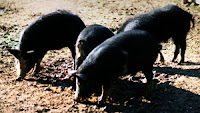 This morning before I started work, I decided to do a little more research on hogs. I already knew that the tamworth is a good option for a pasture based operation, but I wondered what else was out there. I read about a couple of interesting breeds. The first one is the Ossabaw Island Pig (pictured). I came across this one because I decided to check out what pigs they raise at the Living History Farms, which is a living museum here in Iowa dedicated to farming and Iowa’s history. The Ossabaws are related to some of the earliest pigs brought to America by the Spanish and probably came about as pigs escaped farms and became feral. The really interesting thing is that these pigs remained mostly isolated so they have many of the early traits that lend them to pasture living. You can read more about them by clicking on the link above.
The other breed I read about this morning is the Large Black. Like the name implies, these pigs are black. But while they are large, they really aren’t big pigs like some of the modern breeds. They are known for their hardiness and good foraging abilities along with their tasty hams. (That is a good trait!) I came across this breed while searching for information on pastured pigs.
If you would like to watch a four minute video about Caw Caw Creek Farm, a well known pastured pig farm, just click on this LINK which will take you to an article and video from America’s Heartland. It is an interesting video because this is a guy that does pretty well raising pastured pork and selling to individuals and restaurants. I’m not sure if I would use his feed mix though unless I thought it would make me the big bucks!
{ }
by Ethan
on September 22, 2007
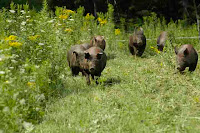 Even though Dexter Cattle are on the front of my mind I have also been thinking about hogs quite a bit lately because they have a much quicker turnaround than cattle. Oh … and I really like pork! While we won’t be adding hogs to the farm until we actually make it to a farm I would like to do some research so I had an idea of what I would like. Because of my love of history I like the idea of using heritage breeds, but the reality of it is that heritage breeds are actually usually more hardy than our modern breeds. And, hardiness is a great trait when you want your animals to forage and live on the pasture. I will do that with my cattle and I would do that with my hogs.
So, today I was doing a little research on Tamworths. Tamworths are medium sized hogs that originated in Ireland (same as Dexters oddly enough). They provide lean meat which is a plus for health conscience people like me (gotta love high cholesterol) and are know for their good nature and excellent mothering abilities. Another thing that I found in my research is that the don’t root up the ground as much as other breeds which makes them great pasture animals. I also came across some great information about their ease of farrowing on the pasture.
My family has raised their fair share of hogs, but it was always in a conventional set up and it was never very fun. I am really interested to learn about raising hogs on pasture … who knows it might actually make it enjoyable!
Here are few links on Tamworths that in checked out today.
#1: Kingbird Farm is located in New York state and the have a bunch of different organic operations going on. The neat picture of the Tamworths going out to pasture is from their farm.
#2: Foot Steps Farm is located in Connecticut and they raise and sell grass fed pork, chickens, and turkey. They have some great information on some “Heritage Breeds”.
#3: This Site is an overview of the Tamworth breed from Oklahoma State University. Just some good basic information.
{ }
by Ethan
on September 22, 2007
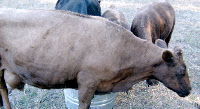 Do you know how some people say that too much of a good thing is bad? Well, I guess that I decided to test that theory out… On Monday we are going to load up and go get some new Dexters (two cows, one heifer, and one little bull calf). If the saying is true I’ll let you know next year, but for now we are increasing our Dexter herd from one heifer and one steer to two cows, two heifers, and two bull/steer calves!
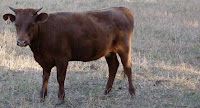 The great thing about these that we are going to pick up is that they are dun in color. Dun is somewhat more desirable in the Dexter breed just because it slightly more rare than the black Dexters. Plus, I really like the look of the duns, especially when they have horns like the heifer does. The two cows have been dehorned, but they should throw horned calves.
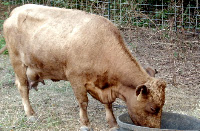 Speaking of calves. The little bull calf is quite the looker, but he is the brother to the heifer and son of the younger cow so we haven’t really decided what to do with him yet. We will see how he starts to fill out and then decide what to do. Possibly we could keep him as a herd bull for part of the girls or trade/sell and pick up a different bull. I would like to get a bull with some color (red or dun) to improve some of the selling value of breeding stock.
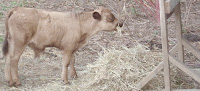 I would like beef to be the centerpiece of our Dexter herd, but I also realize there is still a market for seedstock in the Dexter world so having some color helps that aspect of the possible business. Right now there are roughly 160 Dexters in Iowa so we are slowly becoming one of the bigger herd owners.
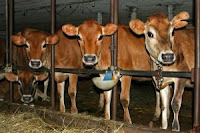
So, we are adding to the Dexter herd even though our Dexters will be over an hour away. Hopefully it will help rejuvenate some of the pastures at my Dad’s place and will give us a good start on a pure breed Dexter herd. The first picture you will see is of the 4 year old cow (the mother of the bull calf and the heifer). The next picture is of the 13 month old heifer. The third picture is of the 10 year old cow that is breed back to a red polled bull (also somewhat desirable). And, the final picture is of the 2+ old bull calf from the 4 year old cow.
I think they will be a nice addition and we can use them to help get things get going!
{ }
by Ethan
on September 20, 2007
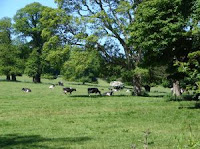 Yesterday I finished reading chapter eight of “Quality Pasture” by Allan Nation. This chapter was entitled Climate and it’s Effect. It was a pretty interesting chapter dealing with temperature, precipitation, and more. As with other chapters it spent a decent amount of time discussing applications with grass based dairy operations, but I also noticed a slight focus on the southern part of the United States which makes sense because I believe he is based in Mississippi.
One thing that I found especially interesting in this chapter was his discussion of shade. Mr. Nation’s contention was that shade is not always needed. He spoke about the ability of cattle to adjust to climates when they are given time and the fact that it is still the same temperature under the shade as in the sun. He believes that you either need to have plenty of spreed out shade for your entire herd or none at all. Another thing he points out is that if you are going to use trees as shade devices they should have all branches trimmed twenty feet up. This will make the shade move quite a bit during the day and will force the cattle to spread out during their day. Another interesting idea he gave was to give cattle multiple small breaks of grass during hot days. His contention is that cattle will forget about the heat if they have enough tasty food.
He also gave a lot of great tips for drought management. The thing about a drought is the question isn’t if, but rather when it will happen. He writes about needing to have a drought plan in place early on in your Management Intensive Grazing progression. It is important that you begin building up a stockpile of stored forages right away because feeding hay in a drought instead of letting them to continue to eat down your suffering pastures will help those pastures bounce back so much more quickly when you finally do get rain.
I’m looking forward to the last few chapters of this book. I have continued debating in my mind the differences between Mr. Nation’s high input methods and the lower input method of Joel Salatin. The more I read the more I appreciate the ideas of Mr. Salatin and I can’t wait to put them to work and see some of the results with my own eyes … that being said, I think my dad will be putting some lime down this fall or winter in order to jump start some pastures for the animals and for our hay. We will see how that goes for our farm.

{ }
 I just finished up reading chapter 10 of “Quality Pasture” by Allan Nation. This chapter was titled, “Seasonal Grass Dairying”. I knew from the title that there wasn’t going to be a lot of specific information in this chapter that would be useful for any operation that I was thinking about at the time, but it was still a good read. Dairying seems to a be an art, kind of like baling or just about all farming, that takes a good amount of knowledge about animals, health, forages, and more. I’m not about ready to tackle that right off (did you read my post about the farmer who hit the end), but I did find a lot of interesting nuggets in this chapter.


Join the Community