by Ethan
on April 12, 2008
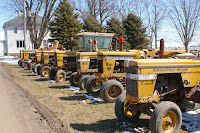 This morning I found an interesting Podcast on the WHO Radio Farm website titled, “Old Tractors-High Prices“. This isn’t really related to cattle, hogs, sheep, beginning farming, but it is somewhat related to buying equipment. I mean it is about tractors and farms use tractors. Actually, it is of some interest to me because I am interested in old tractors and because I am currently looking for an older tractor (some would even call them antiques) to use on the farm for haying and other farm work. In this interview Ken Root talks with Jonathan Welsch, a reporter for the “Wall Street Journal”. Click on the link above to listen to the interview.
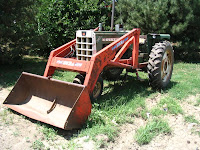
 One more thing on the “Old Iron” front. Yesterday I came across a Farmall 450 with a loader. This tractor was made in the late 50’s and is in the HP range we would need to use our new hay equipment. There are a few of nice things about this particular tractor. First of all, it was painted in the last few years, so it looks fairly nice. Also, the loader is an all hydraulic instead of having a trip bucket which can often be found on tractors of this size and age. Finally, most of these older IH Farmall’s came with a 2 point fast hitch, but this tractor has been upgraded to an after-market three point hitch. That would come in extremely handy!
Of course I’m still not sure if a tractor is even in the cards right now, but we do have some back up plans, so we don’t have to rush into anything. Right now we are still focused on closing on Monday and getting the building up … tractors are somewhat on the back burner, unless I see one that interests me!
{ }
by Ethan
on April 11, 2008
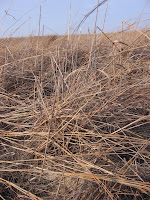 …well, today was supposed to be the day. We were supposed to be closing on the land this morning at 11:00 AM (signing a lot of papers and spending more money that we have ever spent), but because the lender wasn’t able to get the paperwork done we are going to have to wait to Monday morning at the same time. Not really that big of a deal, but still disappointing. I suppose part of the problem is that we chose a lender in Kentucky instead of locally…
We looked at a bunch of lenders, everything from local banks to area lending businesses, and even special agricultural lenders. Ideally we were looking for a lender who would lend us the money for the land and for the building. That didn’t happen! The residential lenders wouldn’t give us a loan because the parcel was to big and the agricultural lenders wouldn’t loan us money because they didn’t like the idea of a pole building as a house.
So, we are going to have two loans. One loan for the land which is going to be through Farm Bureau and one loan for the building. We ended up going with the Farm Bureau loan because they only required 15% down. I realize that is a little low for a down payment, but since we were also going to have to put 20% down for the building loan it was important to us. We did run the monthly payment numbers many … many … many times to make sure that everything would work! One other factor is that we are going to have to pay the CRP buyout from our own money. We couldn’t include that in the loan.
Like I said, I’m a little disappointed. But, the good news is that it is supposed to be 40 degrees and raining today, but on Monday the forecast is for 58 and sunny. At least we will be able to go out to the land and enjoy the nice day after we close … and do some mowing around the building area. After mowing the building area we can stake out the house and get a better idea of present and future building placements.
{ }
by Ethan
on April 10, 2008
 Yesterday I went shopping. Awhile back you may remember reading about whether I should ass Annierent equipment, buy equipment, or hire someone with equipment. Most of the discussion centered around the subject of making hay. On our farm we won’t have a lot of ground to make hay on (unless we find some to rent), but between my dad’s land and my land we will probably be making hay on up to 40 acres this year. Considering the prices of some older equipment out there we decided it would be most efficient for us if we actually owned the equipment.
So, as I said yesterday I went shopping, and now we own the equipment we are going to need to make hay. I found a listing on Craig’s List for a haybine, rake, and baler. With that equipment we would have a pretty good start, so I e-mailed the seller and yesterday I had a chance to check everything out. It’s old used machinery, but it seems to be in good condition and the baler has always been shedded.
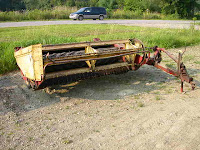
I didn’t take a camera with me, and I wasn’t able to bring it home today because the pasture (some of it is out in the pasture) and the roads are pretty muddy. But, I did some searching on the internet to come up with some pictures of what we bought to get started in the hay business.
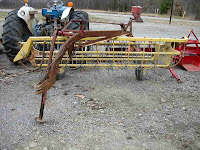 The haybine is a New Holland 469 (like the picture) that seems to be in okay shape. I have never used a haybine before, but when my uncle used to make quite a bit of hay he had a New Holland haybine so my dad used it and there is a good source of information in the family. One plus of using a haybine is that you are able to bale a little sooner than if you just use a sickle bar mower. The rake is just an old Massey Ferguson five bar rake (similar to the one pictured). Nothing special, but it will work great for us.
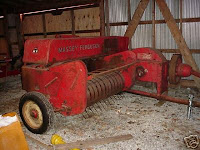 The baler is an old Massey Ferguson #10 baler (the same as pictured, just more dust). It is an old baler, but it has been taken care of and the knotters where rebuilt not too long ago. Before I went to look at the baler my dad talked with a couple Amish neighbors that have or have used Massey Ferguson #10 or #12 balers. They all had good things to say about the bales they make. In fact the only complaint they had was that they were too heavy, so they took to many horses in some people’s opinion. I’m not too concerned about the weight!
So, that was my shopping day. I must admit that I enjoy shopping in another farmers barn and pasture much more than I enjoy a day running from store to store. Even on a cool and muddy day it is better! We have a few options on how we will split up the equipment between my dad’s place and our new place, but most likely the baler will end up at his place since he is further away from his brothers place. I will at least be able to get the hay cut and raked and then pick up my uncle’s baler if I need to. I’m already looking forward to the warm summer days!
{ }
by Ethan
on April 9, 2008
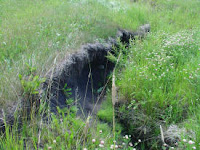 Yesterday I posted a picture and a little description of an area on our farm with a bit of erosion going on. Right now it is not a “major” problem (as some pointed out), but that doesn’t mean that eventually it won’t move from the stage you see in yesterdays post to the stage you see in the picture on the left. The picture on the left is not from my the land we are buying, but I would consider it an unacceptable waterway. It just does not have to be like that.
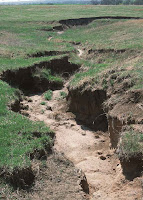 Eventually if nothing was done, and if the place would continuously grazed (not something I’m going to do) the small cut in the ground could turn in to something like is pictured in the right. There is enough water draining down to cause that sort of damage. After time things could get even worse. In fact (and I’m sorry I don’t have a picture of it) if you were to follow that waterway/gully down to where it meets the woods you will see that I’m already beginning to lose part of my pasture from some erosion in the form of a big washout. It is easy to see that the washout is growing and I would really like to help stop that before it goes any further.
In fact, I am not the only one who has realized it was a problem. If you were to head out to the land to day and look down in the washout you would see that at some point (not to long ago) after they took down the exterior fencing they threw it in the washed out area to help prevent more erosion. I am no expert, but I think we can come up with something better than that!
My short term goal is to get someone from the local extension, NRCS, or some other help out here to talk about different seedings that I can do. Also, we have talked about the possibility of mowing and then baling the switchgrass on the land because it could take awhile for the rural fire department to work their way down the list to our names. In that case I had considered the possibility of using some of those bales as filers in the washout. Something to stabilize the edges, but slightly more natural than rusty woven wire.
Next we want to use managed grazing (possibly with some ultra high stock density) to return some nutrients to that area of the land. With the help of our cattle hopefully we can add some more organic matter to the waterway. This will not be an area that we can graze in all conditions, but it is something we can manage as part of the whole and to help improve the land.
In the long run this would be a natural place to put a small pond. I’m not sure how big of a pond this water shed could support, but it would at least be enough to supplement our livestock water. We would not all our livestock access to the pond, but would rather pump out of it (or use gravity) in order to provide water. This is in the long term, but is a possibility. Besides, it would make for a great view from the house!
Those are just a few of my initial thoughts and things that I gleaned from the great comments yesterday. Being a “grass farmer” is my goal, so I want to make sure I am taking care of all the areas on the farm as best as possible. Next time we are out there I will make sure I get a picture of the washout…
{ }
by Ethan
on April 8, 2008

They say a picture says more than a thousand words. So, today I will let the picture do the speaking and just add a few words of my own!
This picture comes from the valley/waterway on our impending farm. As you can somewhat see from the picture, the grass around the waterway is something different than the switchgrass that is on the rest of the pasture. The cut that you see water running in is probably about 100 to 150 yards long and leads to the ravine that runs through the woods. Just on the edge of the woods there is a rather large washout area from the water running down the hill.
Obviously I want to do something to help repair the land here, and I have a few ideas bumping around in my head, but what do you think? I would be interested in hearing what your thoughts are on how I should go about using and repairing this waterway on the farm. I’ll let you know some of my ideas in another post … along with what I learn from everyone who throws in their two cents.
{ }
by Ethan
on April 7, 2008
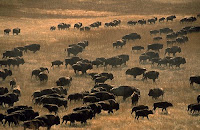 Finally, in the midst of all the craziness, I was able to pick up Julius Ruechel’s book, “Grass-Fed Beef” and make it through chapter one. The first chapter, titled “The Great Herds and Their Grasslands”, acts as an introduction to the idea of herd grazing and the impact on the microbes, soil, and grasses (along with the animals itself). Mr. Ruechel opens with an account of the “evolution” of ruminant grazers and their places in the millions and millions of years that the earth has “existed”. Personally, I could have done without that section and all the points that were made about the “evolution” of these animals really made me feel even more secure in the truth of creation. But, I also probably would be “Expelled” if I were to state my opinions (check out the link).
What did come out loud and clear as the the great herds did a wonderful job of taking care of the grasslands and themselves and we can learn a lot from that fact. They were able to work in conjunction with the soil microbes to break down grass residue and replenish the organic matter in the soil. That organic matter has many … MANY benefits and they are all to often overlooked because of new “advancements” in farming.
After the opening sections (which I didn’t care for) Mr. Ruechel does go into an interesting discussion of what exactly we can learn from the herds and how we can duplicate the benefits of the herd impact. Basically, we need to recreate the herds on our own farms by using fencing (acting like predators) to keep the animals close together and also to force them to move in a “migratory” pattern just as the wild herds used to be able to do. The thing that really comes out in this idea is the importance of management … managing the impact that our “herds” have on an area and moving them at the right times.
One last thing that I found interesting (mainly because of some of the Western arid region ranchers that comment from time to time) was the importance of herds and herd impaction for those arid regions of the country. Mr. Ruechel contends that without that those areas will lose the good and sometimes lush pastures they are capable of having. Food for thought anyways.
All in all an interesting chapter, but I expect I will enjoy the following chapters much more.
{ }
by Ethan
on April 5, 2008
 Yesterday on the Epi-log I posted, “My Top 6 Favorite Farm Food Sites,” for all of the readers. Today I thought I would post my Top 6 Beginning Farmer Sites. These are just some of the sites I like to check out for information, articles, and encouragement. I would love to hear what your favorite farming sites are also!
–National Sustainable Agriculture Information Service – ATTRA (Lots of good links to recent news, legislation, and publications to help farmers)
–Sustainable Agriculture Research and Education – SARE (The name says it all, but they also have links for educators, researchers, and consumers … so it helps connect all groups)
–New Farm (They have changed their website up a bit and they don’t seem to update as often with new articles, but they still have a ton of good information)
–American Livestock Breeds Conservancy (The place to be if you are interested in the importance of minor and heritage breeds … and we probably all should be to some extent)
–Practical Farmers of Iowa (Of course this is very regional and they don’t have a ton of written articles on their site, but it is a great resource for me as it helps connect me with other farmers in my area)
–Homesteading Today (Not totally farm related or even made for farmers, but they have good forums on cattle … pigs … gardening … and just general topics full of knowledgeable people. Plus, good debate)
So, what are some of your top favorites?
{ }
by Ethan
on April 4, 2008
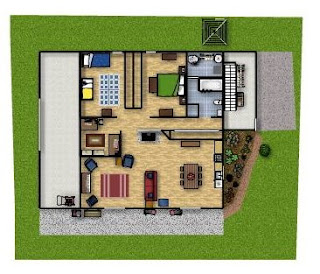 Well, yesterday our realtor called in order to set up a specific time for our closing! For the past three weeks it seems like we have just been waiting in limbo for this day to come, and now we are only seven days away. So, now after months and months of planning and preparing the rubber is about to hit the road. Once we take possession of the land there is still plenty of paperwork to do. Because of the type of building we are doing and because of the small amount of money we are planning on spending we are going to have to work with two lenders. In the next couple of weeks we need to get everything together so we can release land to the building lender and then put together a materials list for them. It makes my head spin just thinking about it!
As I have mentioned before we are planning on building a pole frame building to live in. This type of building will be less expensive to build and go a up a little more quickly. The ability to put the building up quickly is very important to us, because we want the church to be able to sell the parsonage we live in as soon as possible during the good selling season in the spring. So, once the plumbing is roughed in, the building is up, and the slab is down our first order of business will be the bathroom and a kitchen sink! Once we have those we can think about moving in and just camping out in the “house”. It won’t be ideal to live in it while we build it, but it is what we have to do. Of course if the parsonage takes a little longer to sell then we will have more time to build.
Initially we are planning on only building one permanent building on the farm followed by the possibility of a permanent three sided shed once the house is somewhat moving along. We want to see how the farm and the land work before we go planting buildings all over the place, but we do need a place to live and a place to store some hay. As long as it is possible to get water and electric to the building site we have now decided to build on top of the hill. As many people mentioned in other comments it is nice because it gives a view of the entire land and the surrounding area, along with giving a good flat spot to build the buildings and plant the garden.
The building we are planning on having built will be 36 x 45 x 10 (possibly longer depending on how the builder spaces the posts). Also it will most likely have a 6 foot porch running the length of the building. At this point we plan on finishing a portion 36 x 35 which will give us 1260 square feet and a small area for small equipment storage and “garage” type stuff. In the long run if we decide to continue living in this building then we will have an extra 360 square feet to “add on” with out much work.
But, the other plan behind this building (and the reason for the 10 foot ceilings) is to turn this “barn” type building into a on farm store in the future when we build a stick building. At that point we will not need 1260 square feet for the store so we can reclaim part of the building for barn and still have a high enough ceiling for storage. It would give us a neat sales building and a possible location for a certified kitchen if we wanted to go that value added direction.
I told my wife last night that I wish we could just be at the point of building now. I’d rather be deep in debt and working rather than trying to figure out how to get into debt! Oh well, in time … in time …
{ }
by Ethan
on April 3, 2008
bugslife95 porn pics
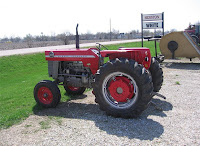 Things have been CRAZY around here! Two weeks ago I started coaching soccer again for my fourth season. I coach varsity high school girls and I really enjoy it, but it does take a lot of time. Each day I spend two-and-a-half to three hours at practice, and things are about to get even busier because games start tomorrow! On the flip side we have a lot of away games this year so hopefully I’ll have some time to read on the bus rides home. What I’m trying to say though is that my blog posts have been a bit irregular lately and I haven’t had as much time to jump into some of the discussion in the comments. But, there has been lots of good ideas thrown around and I’m following along. Keep it up!
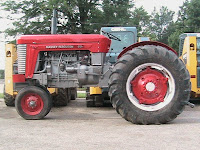 Anyways, back to beginning farming! As we are getting close to closing on the farm and preparing our building plans I am really starting to think about the tools we are going to need. Everything from basic construction tools to a chainsaw to possibly even a tractor with a front end loader. There are plenty of Management Intensive Grazing based farms out there that survive without a tractor (especially one our size). They hire in work done when the need the tractor and save money along the way. But, we are going to be starting out with nothing and a tractor could come in handy.
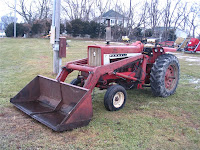 Since our land is completely bare we are going to have plenty of work to do. Everything from clearing pasture to putting up a house will have to be done. Fences need to be put in, trenches and holes need to be dug, a hay shed needs to be put up, some downed timber needs to be cleaned up (for burning), hay needs to be made (we could easily hire this done). And that is just some of the summer stuff. When winter comes we are going to need to be able to clear snow and maybe even move big round bales depending on what happens during the.
 So, with all of that in mind here is what I’m thinking would work for us. A tractor with 45 to 80 horsepower, a front end loader, a three point hitch, a power take off, and it needs to be used! With all of that we should be to take care of most things on the farm, and if we are careful shoppers we might even be able to afford one, we will just have to see.
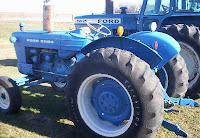 Pictured throughout the post are some of the tractors I have found that would fit our bill. Some of the pictures show loaders and some don’t, but a loader will be high on our list. Also, a couple of them are narrow front end, but we will want a wide front end. The first picture is of a Massey Ferguson 165, next we have a Massey Ferguson 85 (a litter earlier than the 165), after that is the International 706, then the Oliver 1550, and finally a Ford 5000.
{ }
by Ethan
on April 2, 2008
 There was a short article in the March, 2008 issue of “The Stockman Grassfarmer” on passive income for the farm or the ranch. The article relates some of the experience of Gregg Simonds who has gained a reputation for turning around ranches that were losing money. The main reason for the passive income according to Mr. Simonds is because, “Passive income combats commodity volatility.” Of course the main implications of the article are for ranches or larger farms and I small diverse farms are really planning to be part of the commodity market, but there is something that can be taken away from this.
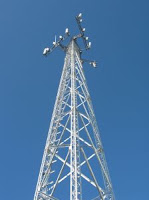
Some of the passive income sources that Mr. Simonds used were gravel mining royalties (not going to happen on a 40 acre parcel) and cell phone towers (don’t really want to look at that, and I doubt anyone wants to build one in the boonies). But, the main point of the article is about leased hunting. According to the article in areas like, “Texas, deer hunting leases can bring as much as $7 to $17 an acre and quail $12 to $20 an acre.” In my part of Iowa some of those deer prices may even be higher because we are the home to a few world record bucks.
Mr. Simonds also goes on to say, “On many ranches, wildlife should actually be the centerpiece enterprise and cattle should be seen as a way to enhance the range for wildlife.” Pretty interesting statement there, but again not very applicable to a 40 to 200 acre farm in Iowa. I the flip side there are a few hunting “ranches” in Iowa that are around 200 acres and up that focus on deer and pheasant with farming on the side.
Even though hunting, cell phone towers, or mineral rights aren’t really opportunities I will be able to pursue on our farm I do like the idea of passive income, or more specifically non-animal/crop related income that is year round. I think one path towards having a successful sustainable small scale farm is finding ways to have income all year long, not just in the growing months or when you send animals to the butcher.
Some people obtain this year-round income stream by selling animals by the cut and finishing at different times of the year so they can have a supply of meat on hand. Others have added agri-tourism components to the farm that while they are somewhat seasonal do add year-round cash flow. On thing that I have considered if we did go the route of agri-tourism or something along the lines of a bed and breakfast is to work out lease deals with surrounding land owners. That would allow more land for things like hunting or wildlife watching. It would also help provide passive income for those farmers/land owners.
I believe some sort of year-round or passive income is an important part of a diversified farm. Joel Salatin may be a perfect example of this. While I do know that he could “make it” without any of his book writing or public speaking, I also know that it provides some year-round income and more diversification on the farm. Hmmm… maybe I need to write a book also … Let’s see, I could write about … Oh, nevermind! I think I’ll stick with something else. I have to many grammatical errors and to short of an attention span to write a book!

{ }
 This morning I found an interesting Podcast on the WHO Radio Farm website titled, “Old Tractors-High Prices“. This isn’t really related to cattle, hogs, sheep, beginning farming, but it is somewhat related to buying equipment. I mean it is about tractors and farms use tractors. Actually, it is of some interest to me because I am interested in old tractors and because I am currently looking for an older tractor (some would even call them antiques) to use on the farm for haying and other farm work. In this interview Ken Root talks with Jonathan Welsch, a reporter for the “Wall Street Journal”. Click on the link above to listen to the interview.
 One more thing on the “Old Iron” front. Yesterday I came across a Farmall 450 with a loader. This tractor was made in the late 50’s and is in the HP range we would need to use our new hay equipment. There are a few of nice things about this particular tractor. First of all, it was painted in the last few years, so it looks fairly nice. Also, the loader is an all hydraulic instead of having a trip bucket which can often be found on tractors of this size and age. Finally, most of these older IH Farmall’s came with a 2 point fast hitch, but this tractor has been upgraded to an after-market three point hitch. That would come in extremely handy!


Join the Community